
Have you ever searched for flight tix, found a good price, waited a few hours to decide… and then watched that price jump?
It feels frustrating. It feels unpredictable. And it often feels like the system is working against you. But what’s actually happening is far more structured than it seems.
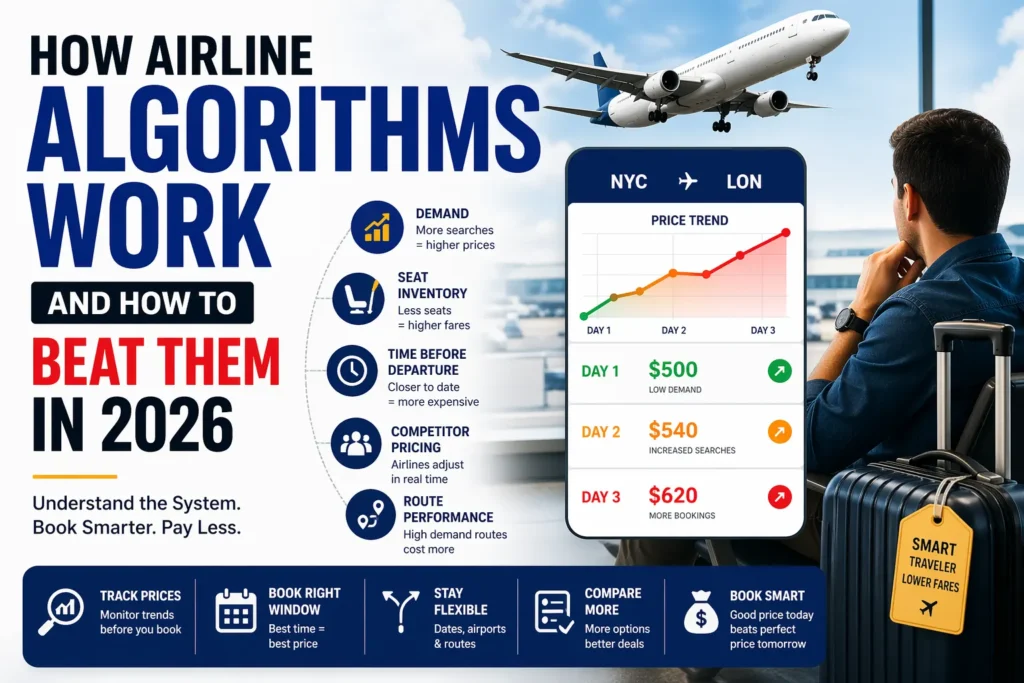
In 2026, airline ticket prices are controlled by advanced algorithms that constantly analyze real-time data how many people are searching, how quickly seats are selling, how close the departure date is, and even how competitors are pricing the same route. Every small change in these factors can trigger a price update. That’s why the same plane ticket price can have multiple values within a single day.
The problem is, most travelers don’t understand this system during air ticket reservation. They treat flight booking like a guessing game checking prices randomly, waiting for a “perfect deal,” or relying on outdated tricks like incognito mode or VPNs. In reality, these approaches don’t address how pricing actually works.
👉 Flight prices aren’t random they’re calculated, reactive, and designed to maximize airline revenue.
This misunderstanding leads to missed opportunities. People wait too long when prices are stable, book too late when demand rises, or ignore early signals that fares are about to increase. But once you understand how these algorithms behave, everything changes.
Instead of guessing, you start recognizing patterns before you book plane tickets.
Instead of reacting late, you start acting at the right time.
Instead of overpaying, you start making informed decisions based on real pricing behavior.
In this guide, you’ll break down how airline algorithms actually work, what factors influence price changes, and how to use that knowledge to consistently book cheaper flights in 2026 without relying on myths or luck.
✅ Read also : What to Do If Your Flight Is Cancelled in the USA
What Are Airline Pricing Algorithms?
Airline pricing algorithms are automated systems that determine and adjust flight ticket prices in real time. Instead of setting a fixed price for a seat, airlines use these systems to continuously recalculate fares based on changing market conditions.
Every aircraft ticket seat on a flight is treated as a dynamic asset. Its price is not static it changes depending on factors like how many people are searching for that route, how many seats are left, how close the departure date is, and how competitors are pricing similar flights.
These algorithms process large amounts of data instantly and update prices multiple times a day. The goal is simple: Sell each seat at the highest possible value while ensuring the flight fills up before departure.
To do this, airlines divide seats into different pricing levels (fare buckets). As lower-priced seats get booked, the system automatically moves to higher-priced tiers. At the same time, it reacts to real-time demand raising prices when interest increases and adjusting when demand slows down. In short, airline pricing algorithms are not random systems they are structured, data-driven models designed to balance demand and maximize revenue on every flight. You’re not seeing a fixed price, you’re seeing a price calculated for that exact moment.
How Airline Algorithms Actually Work
Airline algorithms don’t rely on a single rule they analyze multiple signals at the same time and continuously adjust prices based on real-time conditions. This is why fares can change multiple times within a day, even if you’re looking at the same flight. Each price you see is the result of a system recalculating value based on demand, availability, timing, and competition. Here’s how the key factors work in detail:
1. Demand Signals (Search & Booking Activity)
Airline systems closely track how many people are searching for and booking a specific route.
- When search activity increases, the system interprets it as rising interest
- When bookings start happening quickly, it signals strong demand
- Even a sudden spike in searches (like during holidays or events) can trigger price adjustments
As demand rises, prices increase because the seat becomes more valuable
Example:
- Low search activity → stable price
- High search + bookings → immediate price jump
2. Seat Inventory (Pricing Tiers / Fare Buckets)
Flights are not sold at a single price. Instead, seats are divided into multiple pricing tiers.
- First set of seats → lowest price
- Middle tiers → gradually higher pricing
- Final seats → highest price
As each tier sells out, the system automatically moves to the next price level. Prices increase not because of time but because cheaper seats are gone
Example:
- First 20 seats → $400
- Next 30 seats → $550
- Last seats → $750+
3. Time Before Departure (Urgency Factor)
Time plays a critical role in pricing behavior.
- Early phase (30+ days) → moderate pricing
- Mid phase (14–30 days) → often best value
- Last-minute (<7 days) → highest pricing
As the departure date approaches, airlines expect more urgent travelers who are less price-sensitive. The closer the flight, the higher the price especially if demand is steady
4. Competitor Pricing (Market Reaction)
Airlines constantly monitor competing carriers on the same route, including options like Hawaiian Airlines booking.
- If one airline drops prices → others may match or undercut
- If one airline increases fares → others may follow
- Flash sales or promotions can trigger temporary price drops
Pricing is reactive it adjusts based on what competitors are doing
Example:
- Airline A drops to $450
- Airline B adjusts to $430
- Airline C responds at $440
5. Route Performance (Profitability & Demand Trends)
Not all routes are priced equally. Airlines analyze historical and real-time performance of each route.
- High-demand routes (NYC → London) → consistently higher pricing
- Low-demand routes → discounts to fill seats
- Seasonal trends (summer, holidays) → higher fares
Algorithms prioritize routes that generate more revenue
Why Prices Change So Frequently
Because all these factors change constantly.
- New bookings
- Seat availability updates
- Competitor adjustments
- Seasonal demand shifts
Every small change triggers a price update
That’s why the same flight can have multiple prices in a single day.
Common Myths About Airline Algorithms
There’s a lot of misinformation around how flight pricing works. Many travelers rely on “hacks” that sound logical but don’t actually influence airline pricing. Understanding these myths helps you focus on what truly matters.
❌ Myth 1: Airlines increase prices based on your searches
It often feels like prices go up because you checked a flight multiple times. But in reality, airlines are not tracking individual users to increase prices specifically for them.
What’s actually happening:
- Prices rise because overall demand increases
- More people searching and booking the same route triggers price changes
- Seat availability decreases, pushing fares higher
Reality: Pricing is demand-driven, not user-specific
❌ Myth 2: Incognito mode guarantees cheaper flights
Incognito mode is one of the most popular travel “hacks,” but it’s widely misunderstood.
What it does:
- Clears cookies and browsing history
- Shows fresh results instead of cached data
What it doesn’t do:
- It does not stop airline pricing systems
- It does not prevent price increases
Reality: It helps with accuracy not discounts
❌ Myth 3: Prices are lowest at a fixed time
Many people believe flights are cheapest at specific times (like midnight or Tuesdays).
What’s actually true:
- Prices change based on demand, not time of day
- Airline systems update fares whenever conditions change
- A price drop or increase can happen at any time
Reality: There is no universal “cheap time” to book
Once you stop relying on myths, you start making smarter booking decisions
How to Beat Airline Algorithms
You can’t control airline algorithms but you can work with them. The goal is to understand patterns and act before prices move against you.
1. Track Prices Before Booking
Instead of booking instantly or checking randomly, monitor the route for a short period.
- Track prices for 2–4 days
- Observe whether fares are stable, rising, or fluctuating
- Look for early signs of increasing demand
👉 Book when prices are stable or just starting to rise not after the spike
2. Book in the Right Time Window
Timing is one of the most powerful factors in pricing.
- Domestic flights: 2–6 weeks before departure
- International flights: 4–10 weeks before departure
Booking too early may mean higher initial pricing, while booking too late exposes you to urgency-driven price increases.
👉 The right window balances availability and demand
3. Stay Flexible with Dates and Airports
Flexibility gives you a major pricing advantage.
- Shift travel dates by ±1–2 days
- Check nearby airports instead of just one
- Avoid peak travel days when possible
👉 Even small adjustments can unlock significantly lower fares
4. Compare Multiple Options
Never rely on a single airline or route.
- Compare different airlines for the same route or get help from Southwest Airlines customer care
- Check alternate routes and layovers
- Look at both one-way and round-trip options
👉 More comparison = more opportunities to find better pricing
5. Avoid Waiting for the “Perfect Price”
One of the biggest mistakes travelers make is waiting too long.
- Prices rarely drop dramatically at the last moment
- Good deals are time-sensitive
- Waiting often leads to higher fares
👉 A good price today is better than a higher price tomorrow
Real Example
Let’s see how pricing can change in real time:
- Day 1: $500 → Low demand, more seats available
- Day 2: $540 → Increased searches and early bookings
- Day 3: $620 → Demand rises, fewer seats left
👉 Same flight. Same route. Different prices.
This isn’t random, it’s the algorithm reacting to demand and availability.
✅ Read also : Best Time to Book JetBlue Flights for International Trips (2026 Guide to Save More)
FAQs
1. Do airline algorithms really control flight prices?
Yes, almost all flight prices in 2026 are controlled by automated algorithms. Airlines no longer set fixed fares manually. Instead, pricing systems continuously adjust ticket prices based on real-time factors like demand, seat availability, timing, and competitor pricing. Every price you see is calculated for that exact moment not pre-set.
2. Why do flight prices change so quickly?
Flight prices change frequently because airline algorithms react instantly to market conditions. When more people search or book a route, when seats start filling up, or when competitors adjust their prices, the system recalculates fares. Even small changes in demand or availability can trigger price updates multiple times a day.
3. Can I actually beat airline algorithms?
You can’t “beat” them in the traditional sense, but you can work with them. By understanding patterns like booking in the right time window, tracking prices, and staying flexible you can consistently book at lower fares before prices increase. The goal is not to outsmart the system, but to time it correctly.
4. Do airlines increase prices based on my searches?
No, airlines do not increase prices specifically for individual users. Pricing is based on overall demand and booking activity, not personal browsing behavior. While it may feel like prices rise after repeated searches, it’s usually because demand has increased during that time. It’s market-driven pricing not user-based targeting.
5. What is the most effective strategy to get cheaper flights?
The most effective strategy is a combination of tracking prices, booking within the optimal window (2–6 weeks domestic, 4–10 weeks international), staying flexible with dates and airports, and comparing multiple options. These factors directly influence pricing and consistently help reduce costs. Strategy beats shortcuts every time.
Airline pricing isn’t random; it’s driven by data, demand, and timing. Understand the system, act early, and you’ll consistently book flights at better prices.
👉 Need help finding the best deal for your route? Speak with a travel expert now or use SkyWest Airlines contact number
📞 Call +1 (844) 551-9200